Municipal lighting managers and system integrators constantly encounter tough operational pain points for city street lighting networks. Traditional management relies on manual patrols to find broken lamps. Maintenance teams spend massive labour and fuel resources travelling across urban and suburban road networks. Many hidden circuit faults cannot be detected early; problems are only reported by residents after roads go dark, creating safety hazards for pedestrians and vehicles.
For projects with thousands of lamp nodes, full-coverage regular patrols consume a large share of the O&M budget, yet still fail to capture all equipment anomalies promptly. This NEMA CTN smart street light controller is designed to shift lighting maintenance from passive trouble repair to predictive proactive management.
This system uses PLC + LoRaMesh dual communication hybrid architecture. Each NEMA CTN controller installed on individual lamps continuously samples electrical parameters including voltage, current and power factor locally. The controller judges equipment status and identifies abnormal conditions by analysing real-time electrical data.
Data can transmit over power-line carrier (PLC) through existing power cables, or wirelessly via LoRaMesh radio between adjacent lamp nodes. The collected data flows through the mesh network to GTW730 industrial gateway, which aggregates and uploads data to the cloud management platform. When faults such as circuit abnormality or lamp ageing are detected, the controller triggers local alarms and pushes alert messages to the cloud. Operators receive fault location and diagnostic information remotely. Lighting timing and dimming logic are stored locally inside the controller. Even if cloud or mesh communication is temporarily interrupted, preset lighting rules continue running independently.
Built with hybrid PLC and LoRaMesh dual-communication technology, NEMA CTN collects real-time electrical data from every luminaire in the lighting network. It monitors voltage, current, active power and power factor with high measurement accuracy, providing complete, traceable energy consumption records for asset administrators.
Once abnormal states appear on any street light node, operators get targeted fault alerts immediately. Alarm events cover circuit anomalies, lamp ageing and abnormal power consumption, helping teams discover risks ahead of road failures. Technicians only visit confirmed faulty lamp points, reducing redundant travel and labour workload.
The controller supports offline storage of lighting schedules, dimming strategies and working parameters. Lighting logic remains stable under temporary cloud disconnection or unstable wireless signal. Wide-voltage input design supports deployment in diverse global power grid environments, adapting to unstable power supply common in suburban areas, industrial parks and remote towns.
Paired GTW730 industrial gateway aggregates data from hundreds of street light nodes and securely connects local lighting hardware to cloud management platforms. Open architecture supports integration with mainstream IoT cloud services. Authorized users can view network status, export energy reports and adjust group lighting parameters remotely from web devices.
The built-in sensing module detects lamp pole tilting and collision impact caused by traffic accidents or natural factors. Operators receive early warnings for displaced or damaged lamp poles to prevent secondary safety incidents. This full-network visibility helps reduce unexpected equipment damage, extend luminaire service life and cut long-term operation costs for smart city infrastructure.
Clarify applicable boundaries to avoid unrealistic expectations in project planning:
Different street light control schemes fit different project scales and scenarios:
For large city lighting renovation projects, hybrid networking combining CTN mesh nodes and NB-IoT isolated lamps can be adopted according to actual road layout.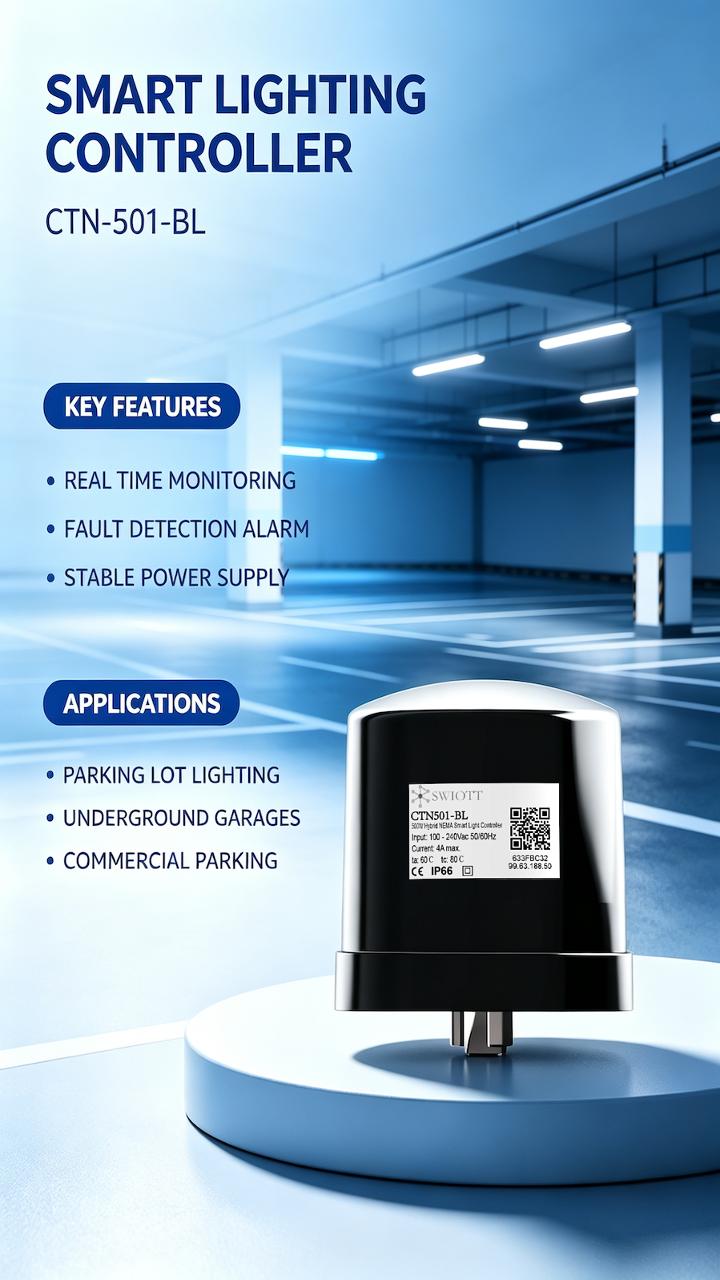
This solution fundamentally changes passive maintenance workflows for municipal lighting. Maintenance teams no longer need full-range blind patrols. Technicians are dispatched only to confirmed fault locations, cutting fuel, vehicle and labour expenditure. Early fault detection reduces dark-road safety risks and minimizes resident complaints.
Precise energy metering helps city managers audit lighting power consumption, implement energy-saving policies and meet carbon reduction targets for smart city construction. Remote parameter adjustment also eliminates the need for field visits just to modify lighting schedules.
SWIOTT NEMA CTN controllers and GTW730 gateways have been deployed in municipal road lighting renovation, industrial park lighting and suburban main road smart lighting projects. Each project completes pre-deployment site survey: power grid noise assessment, NEMA socket inspection, mesh signal simulation and gateway node planning before hardware installation.
After commissioning, the system continuously reports electrical metrics and fault alarms, helping local operators reduce annual inspection workload significantly.
If you are sourcing smart lighting control hardware for municipal retrofit or new construction projects, contact our technical sales team. We provide datasheets, site survey guidance, customized solution consultation and bulk order support for global buyers.


