Industrial-grade engineering requires ruggedized, high-efficiency energy regulation. As an established mppt solar charge controller manufacturer, we deliver robust solutions designed for the rigorous demands of modern municipal smart poles and off-grid utility networks. This integrated costom controller combines maximum power point tracking algorithms with a built-in constant-current LED driver and versatile IoT networking capabilities to provide stable, smart lighting management under harsh outdoor conditions.
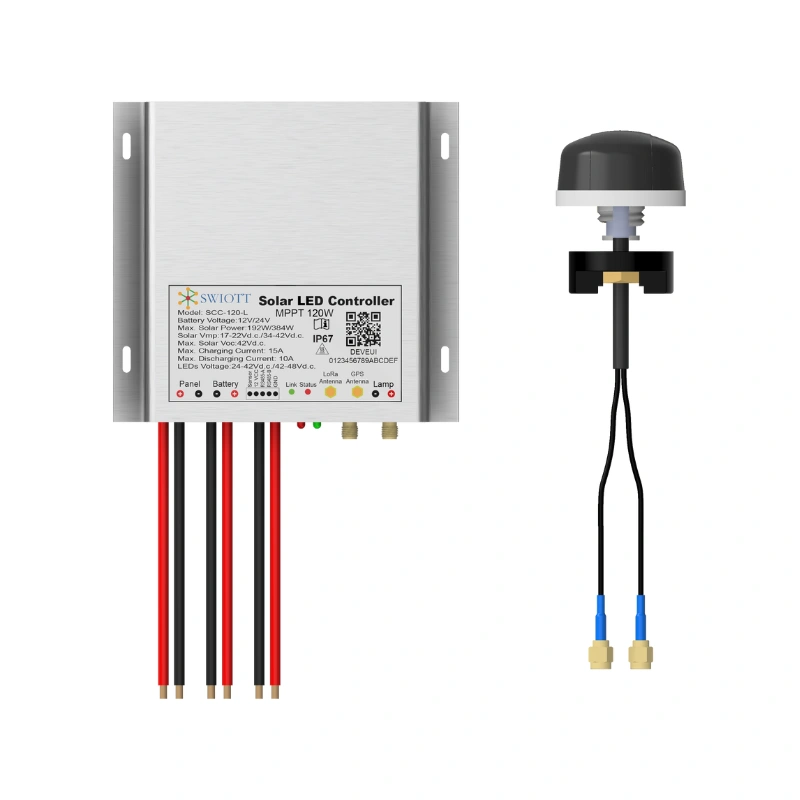
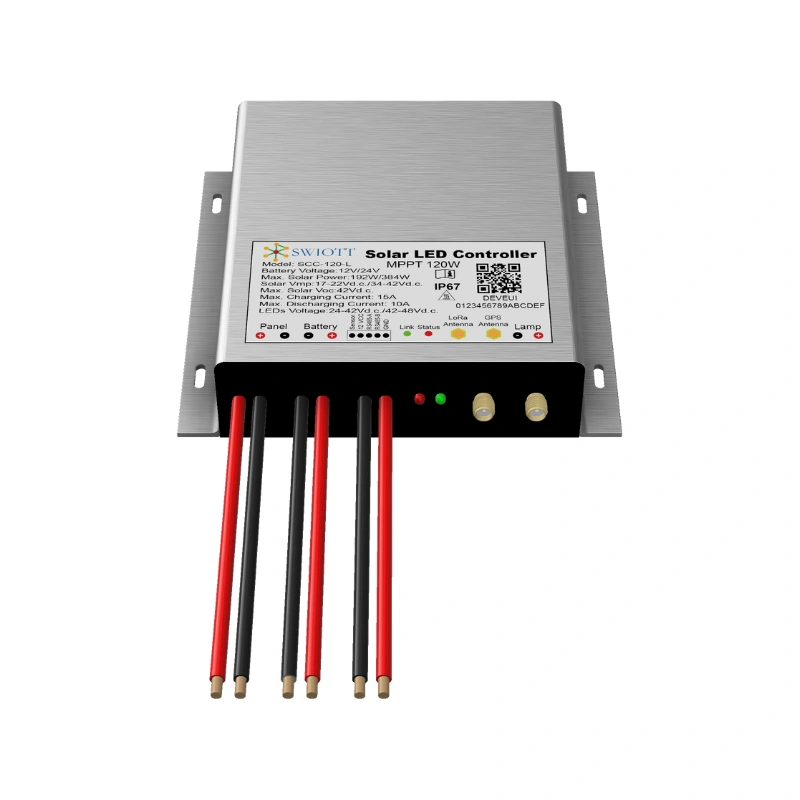
The structural layout of the SCC-120-L eliminates separate electrical component spacing by unifying the central processing core, tracking logic, and load illumination driver within a minimized physical form factor. Optimized for deployment inside compact structural hollows, this specialized costom controller features an advanced embedded tracking configuration to extract maximal localized energy yield during poor solar exposure or high physical tree shading, significantly reducing operational downtime across distributed lighting arrays.
| Technical Parameter | Specification Baseline |
|---|---|
| Rated Load Power Output | 120W (Scaled options: 40W / 60W / 90W) |
| Solar Charging Algorithm | High-Precision Maximum Power Point Tracking (MPPT) |
| IoT Network Protocol Support | NB-IoT, LoRaWAN, autonomous LoRaMesh topology |
| Adaptive Dimming Interface | Integrated Radar / PIR Human Induction Control Mode |
| Configurable Dimming Delay | Programmable parameter window from 1 to 30 minutes |
| Mechanical Housing Rating | IP68 Dust and Waterproof Fully Sealed Solid Enclosure |
| Physical Dimensions & Weight | 13 × 8 × 3.1 cm; Net weight: 0.5 kg |
An analytical examination of configuration rules for municipal road deployment. Read through our engineering criteria for assessing driving load compatibility, dynamic impedance adjustments, and localized thermal stabilization parameters in smart pole nodes.
Investigate how localized wireless data topologies interface with embedded photovoltaic core processing hardware. This study details transmission protocol synchronization and structural node-relay strategies within robust wireless frameworks.
Review empirical performance data tracking the integration of the SCC-120-L across secondary thoroughfares, analyzing the correlation between optimized battery state of charge management and extended multi-year infrastructure lifecycles.
"The integration of the constant-current LED drive and charging core directly inside our smart pole channels resolved layout complications. Operating over a complex distributed network, the telemetry feed from the built-in tracking units remains consistent."
Engineering Director
Municipal Lighting Infrastructure, Germany
"Deploying hardware across isolated off-grid regions requires uncompromising structural resilience. The IP68 casting seals completely against moisture ingress, and the multi-node network auto-recovers without requiring continuous on-site maintenance."
Senior Project Manager
Utility Grid Solutions, Australia
"Under persistent environmental heat profiles, tracking precision often drifts. This professional mppt solar charge controller manufacturer delivers hardware that manages thermal variations effectively while protecting battery state of charge boundaries."
Procurement Lead
Sustainable Smart City Systems, Saudi Arabia
The controller incorporates a continuous high-frequency maximum power point tracking sweep cycle that identifies the absolute peak power coordinates within milliseconds. When partial shading occurs due to urban structures or sudden cloud cover, the tracking logic bypasses localized false peaks, keeping solar energy conversion efficiency optimized by over 30% compared to standard pulse-width modulation regulation architectures.
By unifying charging, discharging, and constant-current LED driving infrastructure into a single localized enclosure, the system completely eradicates intermediate DC-to-DC voltage conversion losses. This streamlined architecture drastically minimizes internal line impedance, controls thermal generation within dense structural smart poles, and simplifies system wiring profiles for large-scale municipal field deployments.
The integrated LoRaMesh network architecture establishes an autonomous, self-healing topological grid where each installed controller functions simultaneously as an endpoint and a signal relay node. If a single smart lighting node encounters localized physical obstructions or radio frequency interference, data packets are automatically rerouted through adjacent nodes, maintaining uninterrupted connectivity with the centralized management platform.
Battery longevity is maintained via an advanced algorithmic analysis of the continuous real-time state of charge. The system assesses historic discharge depths and thermodynamic baselines to dynamically modulate energy output parameters. If solar input drops over successive diurnal cycles, the system recalibrates current distribution thresholds to safeguard core chemical battery cells against degenerative deep-discharge events.
The underlying circuit layout features robust hardware-level safeguards, including transient voltage suppression diodes and physical reverse-current blockades. The system is protected against input-output short circuits, over-voltage spikes from atmospheric induction, and nocturnal reverse-current leakage, ensuring autonomous operational reliability throughout demanding continuous outdoor performance cycles.
External radar or passive infrared sensors interface directly via dedicated digital input signaling lines embedded in the ruggedized harness. System operators can utilize wireless configuration utilities to adjust the adaptive lighting delay parameters from 1 to 30 minutes. This ensures high-intensity illumination upon motion detection before defaulting to ultra-low standby energy consumption modes during zero-traffic intervals.

